Monday, June 24, 2019

Pictures... Books... Picturebooks


Title: Mr. Wuffles!
Author: David Wiesner 
Awards: Caldecott Honor Book
Published: 2013
Genre: Picturebook (Wordless)


Title: Flashlight 
Author: Lizi Boyd 
Awards: N/A
Published: 2014
Genre: Picturebook (Wordless) 


Title: Chalk
Author: Bill Thomson 
Awards: Nominated for the Goodreads Choice Awards Best Picture Books
Published: 2010
Genre: Picturebook (Wordless)


I am no stranger to picturebooks. All my teaching experience has been in the primary grades so there wasn't a day that went by where I didn't read a picturebook to my students. Well, what I thought a picture book was. I always thought a picturebook was just like it sounded- a book with a lot of pictures. So I have to admit I had a hard time figuring out what a picturebook really was. What really is the difference between a illustrated book and a picturebook? I didn't realize I may have had it wrong until I started studying picturebooks. I was relieved to find out that even the Caldecott committee had a problem with this question when they met. They finally came up with these terms and criteria:

  1. A “picture book for children” as distinguished from other books with illustrations, is one that essentially provides the child with a visual experience. A picture book has a collective unity of story-line, theme, or concept, developed through the series of pictures of which the book is comprised.
  2. A “picture book for children” is one for which children are an intended potential audience. The book displays respect for children’s understandings, abilities, and appreciations. Children are defined as persons of ages up to and including fourteen and picture books for this entire age range are to be considered.
When I first was looking into getting 3 picturebooks I went online, typed in picturebook and bought the first three I saw. Parts by Tedd Arnold, A Unicorn Named Sparkle by Amy Young, and Doctor De Soto (Newbery Honor Book) by William Steig. After reading these stories, I know my students will love them. 

Parts is about a 5 year old boy who thinks he is falling a part and starts to stress until his parents tell him that everything is normal. I can already imagine my students laughter and the "eew's" echoing on the walls of my classroom. After I return the book to my classroom library they won't be able to wait to read it themselves. The pictures add detail to the words and truly show how the character is feeling throughout the entire story. The rhyming on each page keeps the story light and fun. 


A Unicorn Named Sparkle is a cute book about not judging a book by it's cover.  A little girl named Lucy orders a unicorn from an ad and dreams about all the fun things she's going to do with her new best friend. She was unpleasantly surprised when her "unicorn" (a goat with a horn) arrives and isn't exactly what she expected. She returns her "unicorn" and soon realizes she loved him despite his flaws and runs after the truck to get him back. The bright and silly pictures will be an instant hit for my unicorn loving students in my class. They will laugh and empathize with both Lucy and Sparkle. 


Doctor De Soto is a book about helping others in need by also being cautious. A mouse who is a Dentist and works on all sorts of animals besides those who would be harmful to a mouse. Doctor De Soto has to weigh the pros and cons when a desperate fox comes by in severe pain. While under sedation the fox mentions how he would like to eat Doctor De Soto and his wife. The couple has to come up with a plan on how to stay safe while still helping someone in need. The illustrations add to the story by allowing the reader to see how the characters feel, how De Soto does his work and the instruments he uses.


Now I'm sure you're wondering why I talked about these three books yet have 3 different ones mentioned at the top. After reading these books I felt like they were fun, and entertaining, and students will love to hear them but when I thought about all the Caldecott winners and picturebooks I have seen over time these three didn't really go into the same category as them. I recently  purchased the three wordless picturebooks mentioned above and shared them with my students and I was blown away at the results.

Mr. Wuffles! by David Wiesner  is a Caldecott Honor Book. My students had such a fun time creating the narrative behind the illustrations in the book. Without a single word in the book they created dialogue,were able to figure out the plot, and tell be what the conflict and resolution was. These pictures were so detailed my students had not trouble "reading" this book and had a great discussion about it. The story involves a cat and some unwelcome visitors who come into his home. The alien visitors work together with some of the home's insects to devise a plan to escape. 

I was shocked to not find any awards for Flashlight by Lizi Boyd. This wordless picturebook is about a child who is walking in the forest at night with his flashlight. Every where he shines his light he finds something new. The story ends with a funny surprise at the end after he trips and the flashlight goes flying. This book lends itself to some great lessons on sequencing. This book also has die-cuts on each page to give you a sneak peek of the page to come. 

Chalk by Bill Thomson was nominated for the Goodreads Choice Awards Best Picture Books. This is another wordless picturebook which lends itself to some great oral discussion. The characters in this story find some magical chalk which brings a world of problems when their chalk dinosaur comes to life. The children have to come up with an idea in order to save each other from the ferocious dinosaur. 


Monday, June 17, 2019

First the...

Caldecott Honor

Title: First the Egg 
Author: Laura Vaccaro Seeger 
Awards: Caldecott Honor Book, Theodor Seuss Geisel Honor Book, New York Times Best Illustrated Children's Book List, The American Library Association Notable Children's Book List 
Published: 2007
Genre: Picturebook 


First the Egg is going to become the new favorite in my classroom library. The author/ illustrator, Laura Vaccaro Seeger not only created the pages to look like canvas, she also used die-cuts to give a sneak peak of the page to come. The colors and painting techniques on each page looked so realistic I actually ran my hand across the page to feel the texture. There is not one white page in the entire story. My students are going to enjoy this simple yet discussion evoking story. Most students will be able to read the book just by looking at the pictures but will be able to learn and discuss components of the life cycles of living things such as the chicken, frog, plants and butterflies. As a teacher of literacy my favorite section is when she compares writing and illustrating to a life cycle as well. "First the word, then the story." I already want to put this quote on the wall of my classroom.

This book demonstrates how complex picture books can be. Words that are so simple yet have a deep underlying meaning. This is going to be a great "go to" book for many science lessons, writing motivation lessons, and illustration lessons.

Tuesday, April 9, 2019

What is there to teach about Writing to Think?

This was a very interesting chapter. I even respected how Bomer mentioned minilessons will not take hold after one lesson, it will take multiple lessons and practice for students to truly understand even one strategy. The next section spoke about the diverse types of notebook entries. It is hard to pick just two of these to write about. As I was reading, I kept saying to myself "ooh I like this one" then I would read the next section and would say " ooh I like this one too".

Even though I liked all of them, there were two that I never have thought of before. The first is compressing entries into a single entry. Many of my students never look back over what they have previously written. I also notice that they write about the same thing over and over again. With this strategy, students take multiple entries that they have made (this will force them to go back and read) and find a common theme between them. Once they figure out what is in common they will write about that theme, which causes the students to synthesize the information. I really like this for my older students. Sometimes they just write about what is bothering them at the moment, but maybe having them see a pattern from their writing will help them see what the problem really is and possibly a solution for it. I know this isn't the reason behind this strategy but it could be a nice result.

Another strategy Bomer mentions is writing from multiple perspectives. Perspective has been an underlying theme in our class this year (which makes me wonder how many of my classmates wrote about this same strategy). The point of this strategy is to write the same event from multiple perspectives. The reason I chose this strategy is because of a student I have been mentoring lately. She is a foster student who has been known as one of the worst behavior problems at our school. The past couple of months she has really opened up to me and I have been able to get through to her any time she has a melt down. One of those days was today. As we were talking she told me what had happened (it was something that had to do with other students and a teacher). We talked through it and I asked her why she thought the students and teacher reacted the ways they did. She was able to realize on her own that she really was at fault in this situation and wanted to go and apologize to her class and teacher. This student has recently told me she is being adopted in a few weeks! This brings on it's own fears and concerns for this student. I have been trying to figure out something to leave this student with before she goes and reading this chapter sparked an idea. I am going to buy her a cute notebook and pens. During our remaining days we will talk about journaling and using the multiple perspectives strategy when she moves to a new school. I pray that she has a good teacher that can find the good in her and take her under her wing but in case that doesn't happen this would be a good way for her to learn to cope and reflect on situations in a better way than she has been doing.

I know that these strategies are more about writing than working through emotions but we all know adolescents have their share of them.

The remaining of the chapter talked about intentional strategies versus assignments. I felt that Bomer wanted to emphasize that a writer's notebook is not a place for assignments but more of a free space for students to express themselves. This is a safe place that they can write whatever they want and that the teacher is invited into as a guest. Minilessons can give students ideas and suggestions about what to write about but ultimately it needs to be the student's decision. If a teacher tells the student that they have to use a certain strategy it puts the student's creativity in a box and will usually be written to please the teacher versus showing what the student really could do.

A notebook is a place full of ideas that can be brought out at a later time and expanded on or explored. This should not be done in the notebook but in a separate space. Teachers can even use this as an assignment by having student reread what they wrote and pick a topic to write about. They then can spend some time putting in entries about that selected topic which can be revised, edited and developed on into a larger writing assignment.

Friday, March 22, 2019

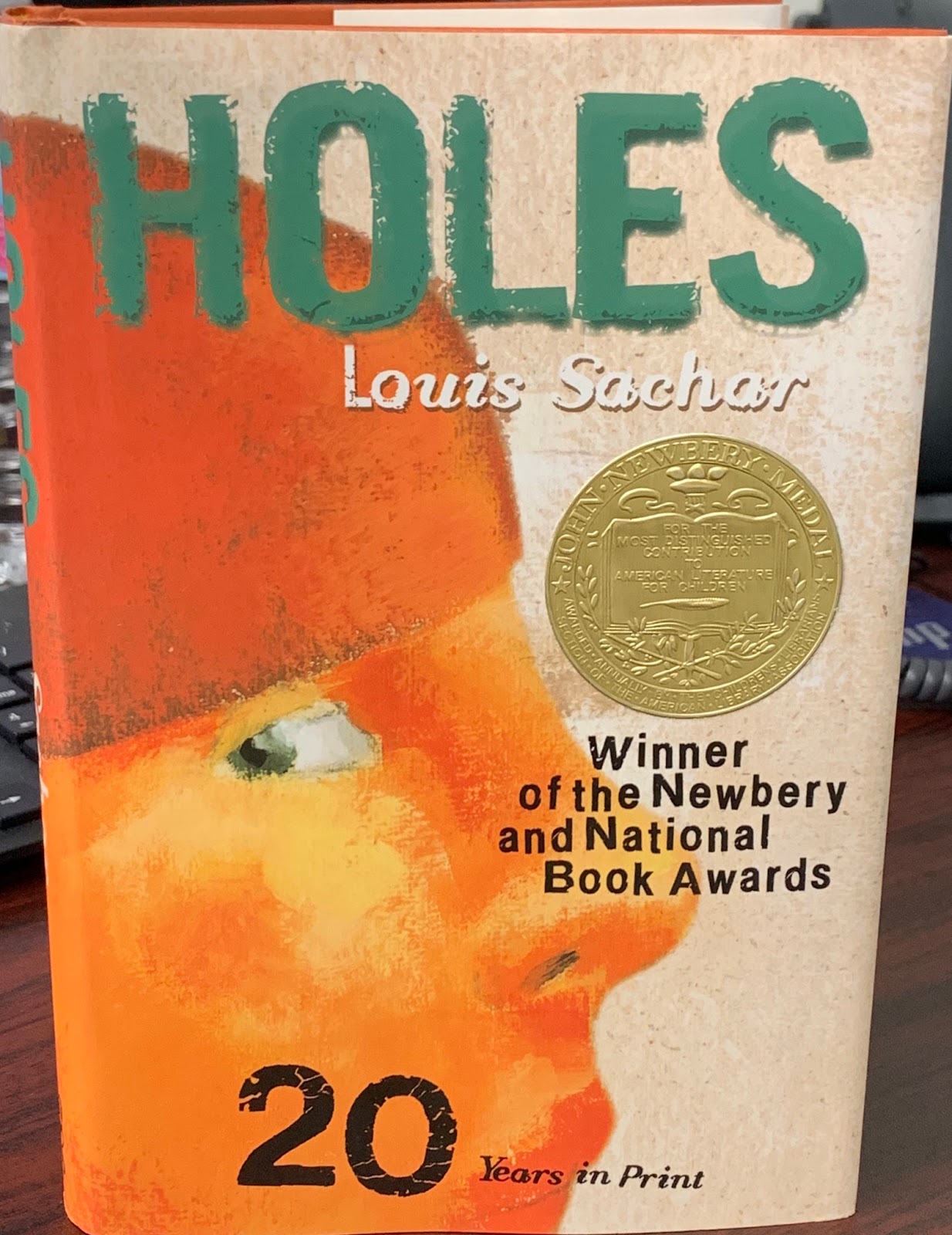
Holes

Award Winning Book #1:

Title: Holes
Author: Louis Sachar
Awards: Newbery and National Book Awards
Published: 1998
Genre: Fiction


When searching for award winning books I came across Holes. I had heard that the book was pretty good and I enjoyed the movie when it came out so I figured I would give it a shot. I wish I would have rad the book before seeing the movie because all I could visualize were the characters from the movie. With that being said, the author still did a very good job of painting a picture for the reader. The vocabulary he uses allows the reader to imagine themselves in the story along side the other characters. 

A young reader will enjoy reading this story about a boy having bad luck and being in the wrong place at the wrong time. Or was it the right place at the right time? Students will be able to discuss how they would behave in difficult situations and how characters change throughout the story. Students have to follow a couple of different story lines throughout the book that intertwine and play off of one another. 

I would recommend this book to all of my students but especially boys who are good kids but sometimes struggle with hanging with the right friends or making the best decisions. 

Monday, February 25, 2019

Memories


If you look through some of my previous posts, you will see that I do not remember much from my childhood. I remember the teachers but not anything specific from their classroom. As I was growing up I don’t think I had a problem learning to read and the only reason I say that is because I have no specific memories about needing extra assistance. I was good at blending in... I was never a behavior problem, I did all my work, and I was so shy that you would never hear me talk. Honestly, if I needed help no one would have known. Thinking back, I don't even know if my school had a library. I'm sure we did but I can't recall where it was located or if we went to it.


My first memory of a read aloud was with my fifth-grade teacher. During October we would combine with another classroom then open the blinds, turn out all the lights and she would read us a book that had "scary stories" in it. I loved it. We were so engaged that when a person would open the classroom door we (including the teacher) would scream. These few minutes each day was a great break from schoolwork and a great escape from the real world. 


Moving into middle school, I remember summer reading lists. I never read more than I had to, and it would sometimes take me the entire summer to become motivated to read but when I did I loved it. I don’t think I have read a book that I haven’t liked. During the school year, I became a pro at using cliff notes to get away with not reading. Reading wasn’t a priority for me or my family. My parents never read unless they needed to, and I could get away with not doing it, so I never did. I have read more children’s books and novels during my time as graduate student than I ever did growing up.


I have struggled with many graduate assignments due to not remembering my past. I really do not have any memories until middle school. This has been hard to pick out important teachers, lessons, and books but it has made me think about my role in the classroom. There is most likely a child that is going through the same things I did if not worse and I can be the one to help create those lasting memories for these students. 


I remember reading a few books when I got into Eighth Grade. Enders Game by Orson Scott Card, The Diary of a Young Girl by Anne Frank, and Night by Elie Wiesel. I have written about this teacher before, but this was an interesting year for me. I had just moved not only to a new school but new school district, so everything was very different and lonely. It is hard to make friends when you don't speak and that makes group projects horrible. I loved reading Enders Game during the summer but was then disappointed when nothing came from that when school started. The Diary of a Young Girl is always a classic and I did enjoy a group project where I oversaw making the script for my group. I never ended up reading Night. This was assigned as "silent reading" in class and I always had a hard time concentrating with all the commotion that was constantly happening in the room. This was also during the time that my teacher put a note on an essay I worked hard on that said, " you had no heart when writing this".  Once I read that comment I did the minimum to get by and was not motivated to do anything extra for this teacher. 


Monday, February 18, 2019

BHH


Book:
In A Tale Dark and Grimm there is a narrator who is telling the story. The narrator talks to the reader throughout the book informing and warning us about what happened and what is about to come. The story is the true story of Hansel and Gretel. The book begins with the story of their father and his faithful servant. The servant had served this family for many generations and had "under-stood" them. He went above and beyond to keep them safe to the point of turning to stone for what the kingdom thought was treason. After they realized he was protecting the king and queen they brought him back to life by sacrificing their own children. These children (Hansel and Gretel) were brought back to life but were so afraid of their father that they ran away. The story follows Hansel and Gretel as they ran away and then make their way back to the castle fighting evil along the way. 

The author warns us the entire time that this is the true story of Hansel and Gretel and it's not the fairy tale that we have edited down for children these days. He wants us to know that the true story is dark and bloody. 

Head:
The author expected us to know the fairy tale version of Hansel and Gretel. The book was a lot darker than I had realized. As the chapters continued I thought to myself, "this can't get much worse" but it did. I think the most surprising chapter was “a smile as red as blood". This chapter was about a man who was infatuated with young girls. He would play with them and then eventually lure them into the woods alone where he would chop them up and eat them and trap their soul in cages (embodied in a white dove). I was very surprised that there was a chapter like this in a children's novel. All the red flags started going off as Gretel became more and more bewitched by this young man and wanted to be alone with him. I guess it does strengthen the point of stranger danger but not in a way I would have imagined. 

As I was studying for another class I made a connection with the story that would add a cool back story if it was true. Hansel and Gretel's mother is extremely obsessed with gold. To the point of accepting being kidnapped by the King because he had gold for her. This made me wonder if possibly she was the daughter of King Midas. 

Heart:
This book helped me realize that as a reader I enjoy mystery and gory stories. When I was reading I loved predicting where the story was going and what would happen next. I also realize that I can get annoyed with a book. When a character makes wrong decision after wrong decision, I can start to get frustrated. Luckily by the end the characters began realizing there mistakes and fixing their wrongs allowing for some relief. 

I also realized that trying to shield our students from dark and gory stories and "fluffing" everything up can be a big disservice to our kids. Teaching them everything always has a happy ending and everything always turns out fine sets them up to be shocked when life isn't always that way. 

Monday, February 11, 2019

Reading and Writing Reflection

How would you describe the best reading experience you could possibly have?

- To have my best reading experience I need to be away from home. At home I end up falling asleep or doing something to distract myself or avoid reading (such as watching TV, playing on my phone or cleaning). I tend to read very well on long road trips. When everyone starts to quiet down and listen to their own headphones, I can pull out my book and get lost. I am not worried about a time limit or something else I can do with my time,  I can just read. 

How would you describe your very best writing experiences?

- My best writing experiences happen when I have nothing else to do at the moment. I cannot multi-task when I need to write. This even included working on these blogs. I have to be able to have a decent block of time where I know I do not have to stop and get up to do anything. I like to be alone or with other people quiet in the room and prefer to be at a desk or in laying in bed if I am journaling.  

How do you set up these things for the best reading or writing time you could possibly have?

  • Light- Natural light or all lights on in a room. If I just do a book or head light I tend to fall asleep. 
  • Music-  Reading:This depends on what I am reading if it is for fun I  need some background noise on because if it is too quiet I get distracted in my own thoughts. However, it needs to be something I am not interested in or I will also get distracted and start singing, watching or join in on the conversation. If it is a text book or something I really need to focus on I need it completely silent. The TV can be on but it has to be muted, no music, and no conversation or I will reread the same sentence multiple times. Writing: I am not as picky when it comes to writing. As long as I know what direction I want to go with my writing, it usually doesn't matter if there is noise or not in the background. 
  • Body Position-Reading: I need to be sitting up like at a desk/table, or in a car, or curled up on the couch. If I lay down I soon become distracted.  Writing: If I am doing something like journaling I can usually be in any position but to do my best homework I need to be sitting up at a desk or table. 
  • Food and/or Drink- Doesn't usually affect me. 
  • Wiggling or being still- I have to be still but If I am in a rolly chair I tend to swing from side to side.
  • Nearness of other people- Other people usually do not bother me as long as they are still and quiet. I prefer to be alone when writing and have only a few people near when reading but if they are talking or moving I easily get irritated and cannot concentrate on what I am doing. This was a big problem for me in school. Still today in professional developments and classes when teachers ask me to read something quietly I have a hard time doing it due to the other people in the room. If I can get through it it takes me a very long time especially when reading something. 

How long does a writing or reading session need to be for you to get really involved in and get a lot of work done?

-Reading: For reading for pleasure I need just a little than 5-10 minutes in order to be really involved. I can take my book when I am riding with someone in the car and read while going someplace and I can also read during transitions between my groups. As long as I know where I left off in the book and remember what just happened I can jump right back in. If I have to go back and refresh my memory because it's been a while since I read it then it takes me a little longer to get started. If it is a textbook, I need at least a 30 minute time slot in order to read. I know I have to focus more and it takes me longer to get into it so if I don't have that time I avoid it. Writing: For writing it also depends on what I am working on. If it is journaling or a quick write I don't have a set amount of time needed but if it is an assignment I usually will not even try to begin unless I know I have the time to finish it in one sitting. 

What is the best place for you to get lost in reading?

- The best place for me to get lost in reading is a place where I have nothing else distracting me. I remember reading an entire book in a day last year because I went with my fiance when he was helping his brother install a new radio in his truck. I sat on the front step while they worked and just read. It was fantastic. It was a gorgeous day and I had nothing else I needed to do. I could just sit and relax with a book. 

A Few Ideas

Hi Readers! We are all in uncharted territories so I wanted to give y'all some resources and ideas I have seen in the last couple of w...